Orthic Labs / Notes / Productization
Productization · open source software vs commercial software
Open Source Software vs Commercial Software: The Real Difference
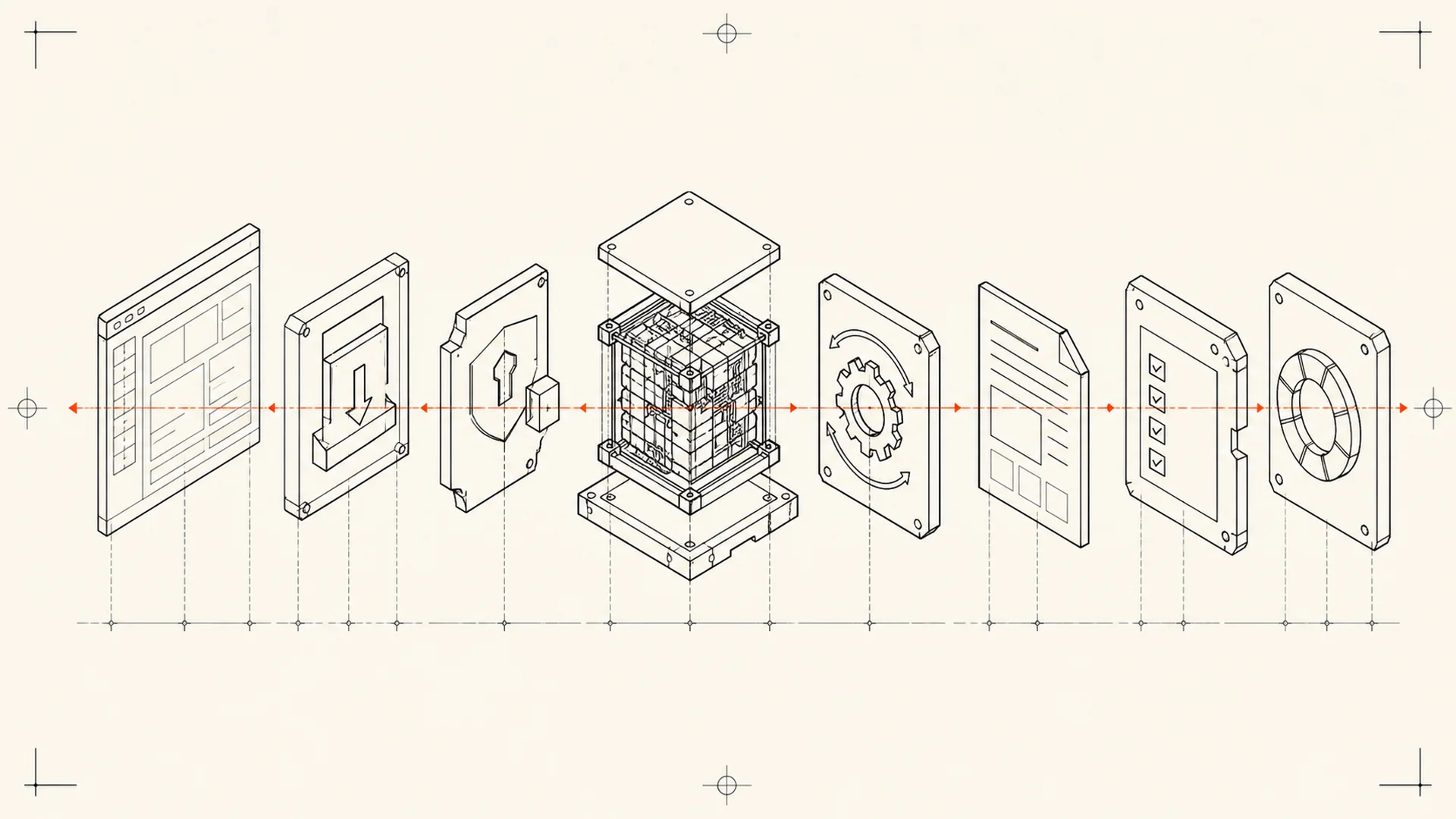
Open source software and commercial software are not opposites. Open source describes license rights around source code; commercial describes an economic activity. A product can be open source, commercial, both, or neither.
The more useful comparison is not “free code versus paid code.” It is source, product and service: what rights you receive, what work has already been done, and what continuing obligations someone accepts.
Start with the words
The Open Source Definition requires more than visible source. It covers redistribution, access to the preferred form for modification, derived works, non-discrimination and technology-neutral rights.
“Commercial” does not describe a license. It means software is connected to commerce: sold, supported for payment, used to deliver a paid service, or maintained inside a business. Many commercial systems use open-source components. Many open-source projects have paid products, hosting or support around them.
The first mistake is forcing one axis into two camps.
Compare the things a user actually receives
| Question | Source distribution | Finished product | Managed service |
|---|---|---|---|
| Can you inspect or modify source? | Depends on license; often yes | Depends on product license | Usually limited |
| Is there an installer? | Sometimes | Expected | Usually unnecessary |
| Are dependencies packaged? | Sometimes | Expected | Operated by provider |
| Are defaults chosen? | Often left to operator | Expected | Expected |
| Are updates delivered? | Pull and rebuild may be required | Product update channel | Provider deploys them |
| Is support included? | Community or maintainer-dependent | Defined product support | Defined service support |
| Must a provider remain online? | Usually no after setup | Depends on architecture | Usually yes |
| Is payment recurring? | Not inherent | Any model is possible | Common because operation recurs |
No column is automatically better. The correct choice depends on whether you want to maintain the machinery or use the output.
What a repository gives you
A good repository can give you something a closed product cannot: inspectable implementation, the right to modify it, a public issue history, reproducible builds, community knowledge and freedom from one vendor's roadmap.
But those advantages are useful only if the license grants them and you can exercise them. Source access does not automatically provide a stable binary, a compatible runtime, model files, installers, signing identities, release QA or support for your machine.
That is not a criticism of maintainers. A public project can be excellent while explicitly serving developers rather than non-technical users.
What a commercial product can add
A product publisher can take responsibility for the work around the core capability:
- Select and test versions that work together.
- Review redistribution obligations.
- Package runtimes and assets.
- Build the complete workflow rather than expose isolated commands.
- Sign Windows and macOS releases.
- Maintain update and rollback paths.
- Test supported hardware and operating systems.
- Write customer documentation.
- Answer support questions.
That process is software productization. It is a legitimate thing to charge for even when an important ingredient is available under an open-source license.
What payment does not excuse
Charging money does not prove the product is better, safer or more durable. A commercial publisher still owes you clear answers:
- Which version or rights continue if you stop paying?
- What data leaves your machine, and why?
- Which operating systems and hardware are supported?
- What is included in updates?
- Where are your working files stored, and can you export them?
- What support is included?
- Which open-source notices and license obligations apply?
A price tag does not replace those disclosures.
When source-only is the better choice
Choose the repository when you need to modify the software, audit implementation details, integrate it into another system, keep control over the build chain, or contribute fixes upstream. Technical teams may also prefer source because they already have deployment, security and support functions.
Source is also the stronger continuity option when the license and build instructions make independent maintenance practical.
When a productized build is the better choice
Choose the product when you want a supported installer, predictable workflow, tested defaults, documented boundaries and an update path. That is especially reasonable when maintaining the environment would cost more time than the purchase.
The useful calculation is not “the repository costs zero.” It is:
What must you operate yourself, what does the publisher take responsibility for, and which rights remain yours?
Open source inside an ownable product
Orthic's position is simple: upstream work should be credited, license obligations should be respected, and the added product work should be stated plainly. The customer should not be told they are paying for the invention of a public model. They are paying for the finished system built around it.
This model also imposes discipline on the publisher. If the core job can run on the customer's computer, recurring server costs should not be invented to justify rent. If an external service creates a real recurring burden, that exception should be visible.
Mistakes to avoid
Assuming visible source is open source. Check the actual license and its redistribution terms.
Assuming open source means no cost. Operation, integration, maintenance and support consume real time even when license fees are zero.
Assuming commercial means closed source. The two labels describe different dimensions.
Treating community support as an unpaid service-level agreement. Maintainers choose what they support; customers should not silently transfer product obligations to them.
Ignoring continuity. Ask whether you can keep the installed version, retrieve the installer and export your data if the publisher disappears.
Frequently asked questions
Is open-source software always free of charge?
No. Open-source licenses protect specific freedoms and redistribution rights; they do not forbid selling the software. “Free software” also refers to freedom rather than price in the GNU definition: What is Free Software?.
Why pay for software built with open-source components?
Payment can cover selection, integration, optimization, interface work, packaging, signing, updates, QA, documentation and support. The publisher should identify that work instead of implying ownership of the upstream ingredient.
Is commercial software more secure?
Not automatically. Security depends on architecture, maintenance, review, release controls, dependency management and incident handling. License and business model alone do not prove security.
Can a proprietary product include open-source software?
Yes, when the product complies with every applicable license. Different licenses impose different notice, source-offer, attribution or redistribution obligations, so publishers must review the exact dependency set.
Follow the production line
Read how software productization works, use the local-first software test to inspect architecture, then compare the seven apps in RightSuite. The point is not to choose a tribe. It is to know which rights and operating responsibilities you are accepting.
About Orthic Labs: We are an independent software publisher. Read how Orthic Labs works and why we treat open-source ingredients as the start of a product, not the finished product.